Tech Talk: The Game Industry and Button Remapping

You are a player and you’re sitting at home with your friends about to play your favorite game. The game you’re going to be playing is on a console, and that console you own has a controller with about 16 different button inputs attached to it. Everything from the start button the trigger bumpers, which almost come standard now in new controllers, are all present for your available hand’s desires. Now imagine though that you’re a gamer, who has no use of their hands, or no use of one hand – how does this now limit your enjoyment of your favorite game? You can no longer do actions you’re used to – do you preserver and try to overcome? – or do you RAGEQUIT and storm out of the room, ashamed that you no longer can do an activity you enjoyed to your fullest potential?

On today’s Tech Talk we dive head first into the deep underbelly of the game industry and we come up with a rather interesting image. Disabled gamers aren’t able to enjoy console games like most players’ can, and this is a sad, unfortunate truth. In a video provided by AbleGamers.com’s Youtube channel, they give a visual perspective on just how large a scope disabled gamers must deal with in the console market. These individuals are precious and important, because their lives matter, and because they matter we should aim to making their lives as enjoyable as possible. Button remapping could change the game on the way disabled gamers are able to interact with video games, as well as possible one-touch input controllers for one handed gamers, and that will all be discussed here.


Button remapping, for those who are not aware, is a function where a player is allowed to assign an input value to a given button on a controller. PC games are notorious for using them, and are commonly referred to as Macro keys, or hot keys, on most MMO’s or online games.  The problem is, the PC market is only one market. You are then excluding all players who wish to play console games, but can’t due to a physical impairment that they have no control over. The opposition would claim that most console games do eventually come out to PC. True, but not all PC games have Macro settings either, and lots of them require multiple keys, and inputs to perform one task.

I have trolled Youtube forums, and been to many game discussion boards about button remapping and it sickens me when I see comments from people who say that if given button remapping that may “give any player an edge, if it’s presented openly.” So the opinion is, that if designers gave players the open free will to map their own unique layouts to their controllers that somehow – there’d be an uprising of hackers who would learn to dominate the games systems?

Are you kidding me? Disabled gamers are already impaired and all they want is a fair and balanced shot at playing any game just like you. Does that mean the skill of competition may rise up in a Call of Duty game if you give a man with one hand the option to customize his outputs? Possibly – but what does that say about you as a player if you’re the man who gets owned by said player? It doesn’t mean he, or she, cheated the system, it means that given a fair playing field, disabled gamers can be just as good, if not better than able gamers. Now I’m not trying to turn this into a rant, and we’re here to talk tech – not controversy – so I’ll move on. Button remapping is important, and should be thought of as a viable addition to new games.

Most games now come with a pre-determined output setting, or give you an option of a few multiple presets, assuming that these outputs are the norm for folks. I personally have function of both of my hands just fine, but can you imagine the percentage of gamers in America that deal with loss of limbs, malfunctioning digits, muscle movements, and other physical aliments that don’t allow them the luxury to use these presets?  That’s why button remapping is important, because despite the naysayers and the apparent expense behind it to add the functionality, the ends would justify the means. Developers would be helping to serve their fellow man, or woman, gamer in ways we never assumed possible.

Here’s another video on a product that was designed by Evil Controllers [ link in the sidebar.] called the Adroite Switchblade. Granted the one presented here is a prototype and the number he announces in the video would make any morphine strapped gamer vomit in his bedpan at the estimate – but that’s the thing. It’s a prototype. It’s there for an example of what could be a great option in the development of games and hardware. I hope that it makes it to a mainstream market, because it’s very much needed for disabled gamers to feel a part of something very special. Developers have focused so much on the need for motion control that I often wonder if they’ve even considered how many gamers lack that very key principle to the products they devote games to? Easily optimizable controls, HUD display changes for the vision impaired, and well – basically giving a gamer customizable outputs changes the accessibility of a game tremendously overall.


So what are your thoughts? I want to hear from others; if possible, do you feel that button remapping is an unfair advantage to the already disadvantaged? – And if you agree that button remapping should be implemented into consoles – how do you think companies should go about doing something like that to provide an equal playing field for their games? Feel free to watch the videos, comment, and visit the corresponding sites for more info on their causes, projects, and efforts in fixing the industry to help disabled gamers become just as immersed as the rest of us. Next time we’ll discuss money in the market and how much developers lose when we don’t recognize these concerns for the gaming market. Thanks guys for reading and enjoying and I look forward to your opinions!

– Chad K.

Inspirational Gamer of the Week: Mike “Broly” Begum

Today is Thursday, which means, it’s time to find a gamer out there that may give some enlightenment to the needs of disabled gamers. Here I wanted to show that disabled gamers can play just as well as abled gamers. The only difference between disabled gamers and abled gamers is that disabled gamers usually have to figure out and master a form of gaming that fits to them. This doesn’t mean that all games are accessible to them, but my goal here is to show how some have adapted their gameplay to fit the mainstream market. Broly is an example of a gamer who has overcome his condition to adapt it to play fighting games – games that he loves and enjoys. This video I’m posting was an interview done with Broly by Gootecks from CrossCounterTV.

“Broly” suffers from a condition known as arthrogryposis. Seattle Children’s Hospital Orthotics Department defines the condition as “a problem with muscles that causes them to contract so that they are rigid. This affects your child’s movement. It also affects shoulders, elbows, wrists, hands, hips, knees, and feet.”

Children’s Hospital also hosts a support group for patients with the condition. Feel free to browse their site to find out more information on Broly’s condition if interested. Now, why is this guy so inspirational to me? Well here’s the thing: He only really has limited mobility in one of his hands, and he plays the rest of the buttons with his tongue! The guy is amazing and if you take a moment to watch this video you’ll see why. He has some profound words of encouragement for fellow disabled gamers. He, just hands down, is a really wonderful example of why bringing disabled gaming to a forefront would be an outstanding effort on the part of the gaming industry.

Last year his friends and supporters raised enough for him to go to EVO 2011 and compete in the Street Fighter IV tournament. This year he is hoping to do the same. If you would like to help his cause and allow him to represent disabled gamers on one of the most competitive battlegrounds on the game industry calendar please feel free to visit his Facebook support page, which I will link here:

http://www.facebook.com/pages/Send-Broly-to-Evo-2011/211326905560713

Now why did I do this today? Why is it important as able-bodied gamers that we see examples of gamers like “Broly” succeeding like this and overcoming control schemes that would usually be daunting for even the most seasoned veteran? – because I want to make it know that the market is there. Gamers like Broly, I am sure would prefer, if they had the option, to play at a more comfortable level. If we, as designers, can begin to make concessions in our design plans to fit gamers like Broly, then I think the gaming industry could gain a major boost to revenue streams.

He already plays the game well in his physically challenged state, but by adding that extra sense of comfort, or giving him an option for a more comfortable control scheme – you open up a world of feeling competitive. This could definitely aid others like him who may have even worse conditions who wish they could be competitive on his level. There are probably countless kids and adults out there who would love to play a fighting game, with analog sticks and the like, but they can’t because they are hindered by lack of movement, loss of limb, or other impairment. Take a moment to read this article, look at the information provided, and if you want to help Broly get to EVO 2012 please do so. He’s a great face for the disabled gaming community, and thus, why I give him my seal of approval as Inspirational Gamer of the Week. Way to go man! Keep on KO’ing the noobs one tongue click at a time!

– Chad K.

Gaming With A Cause: Where’s My Water?

Hey there folks. Now I know today I just released an opening statement to the mass internet populous about being an advocate for the disabled gaming community, and I am wholeheartedly, and it’s not often when a game comes along that I find would be an excellent casual game for physically challenged folks, while also helping raise money for an entirely different charity at the same time. Neat huh? Now sure you’ve probably seen by now my links to sites that deal with getting more information on medical conditions, or other disabled gamer websites which you are free to check out and enjoy if you’re curious. This, however, is my first game to be reviewed on the premise of accessibility – so I hope I do well! [ If I don’t and you feel there are points I may have missed, please feel free to let me know! I love feedback from fellow gamers and it really helps me grow as a writer and developer.]

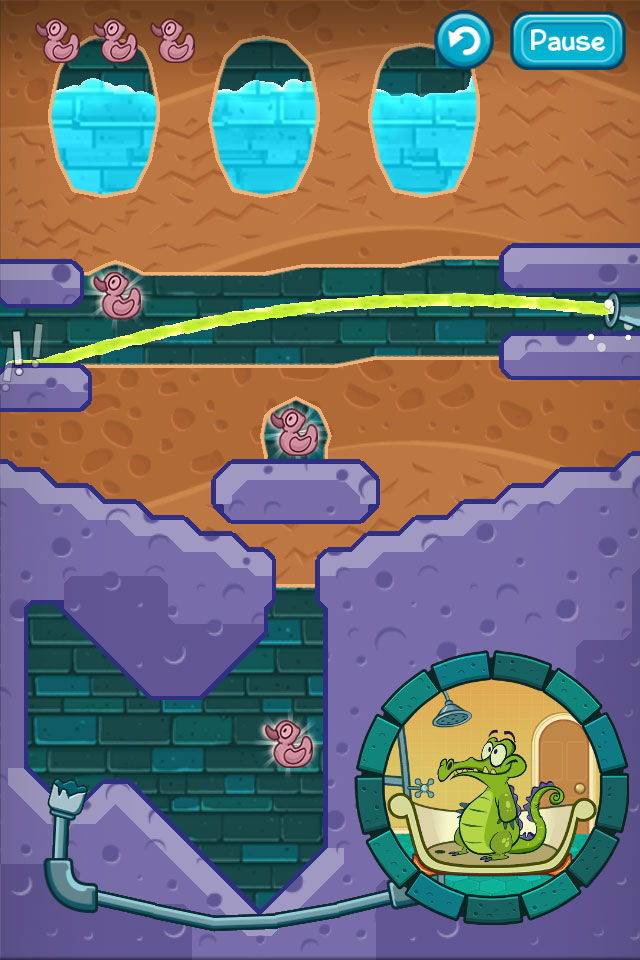
So, what game are we talking about well it’s called “Where’s My Water?” designed by Disney Mobile.

Now you’re probably thinking to yourself – “Oh come on Chad! A Disney game? I’m all grown up – what do I need with a Disney game?” – well, there’s a special reason behind this game that I think most folks will enjoy, and it’s highly accessible to all types of groups.

In “Where’s My Water?” we’re introduced to this lovely and adorable looking – alligator named Swampy. The essential scheme of the game is that Swampy is an alligator who loves water, and thus, loves taking baths. The game uses physics and your mouse dragging to guide the water through puzzles that ultimately have to end up getting into the pipes so Swampy can be clean. So why is this important at all? Well, I’m glad you’re concerned. The ladies and gents over at Disney Mobile have started a movement that I am in total support of. They have teamed up with Conservation International to help raise money for helping conserve ecosystems and fresh drinking water for families all over the world.

How does this relate to the game? Well, “EVERY DUCK COUNTS” is their slogan. Every good alligator needs a rubber ducky to accompany him to the bath. In the game as you try to get the water to Swampy and his many other bathing pals throughout the game, if you let water hit the ducks you gain extra points for every duck you gain. For every duck collected it goes towards the total donation amount that Disney and Conservation International are able to provide. So, now on to the important part: How is it an accessible game, and for whom is it accessible? Well, I can only provide my first hand experience, but I’ll give my take on the gameplay to the best of my ability.

The gameplay is smooth and it really is a click and drag, almost one-button input technology. You really don’t have to do much more than dig a path for the water to go or press a valve to make water spray from it. This is great for patients who lack major muscle movement and can only move one hand. The puzzles, while easy at first, do get rather difficult as you go on – so gamers with cognitive impairments may have trouble playing the game in later stages, but overall the game looks and sounds great. The sound isn’t a requirement to play the game either, which gives deaf app users the ability to play the game flawlessly. Sadly the game really isn’t set up for blind players, as it requires you to be able to see the pathways of the water to make sure you gain success, but overall the game functions incredibly well for a wide audience of players – and it’s helping out a wonderful cause. What more could you ask for?

The game is available in the iPhone App store for FREE, and you can play for FREE online here. I do believe that it’s available on the Android market too, but I’ll check and get back to you folks. Here’s a link to the game, please enjoy and get to duck huntin’ – that water’s not going to move itself!

http://disney.go.com/wheresmywater/game.html

I Have A Dream: Game Accessibility For All

I remember when I was younger the joy I used to get when I held a Nintendo controller in my hand for the first time. I remember the colors and the vibrant energy I grasped hold of every Saturday morning as I led Mario to his ultimate victory of saving the princess again and again. The realization though that I’ve come to in the past few years is that for many children, this is not the case. I may have disabilities, but they don’t impair my cognitive skills, nor most of my motor skills. There are plenty of kids out there though that do suffer from physical and mental complications and difficulties that inhibit what games can be enjoyable and playable and which games can’t. This, to me, is a heartbreaking reality, which needs to be fixed. I’ve been in a wheelchair quite a few times in my life, and I can only imagine what it would be like to have lived your whole life confined to one with only limited movement to provide means of entertainment.

Games are not only toys, but they are wonderful means for us all, as human beings, to communicate, connect, and engage in entertainment with one another that we otherwise couldn’t in our real lives. In most games a player can become a hero, or a villain, and impose their wills on the world around them. This gives the player a sense of euphoria and accomplishment, but also a sense of release. I know there are often times when I’m going through back pains or muscle spasms that I’ll sit down and play a game, and all the tension or frustration I was having over my own body attacking me goes away. I become one with the game and I lose myself in a world momentarily for entertainment. There are countless gamers who do just that, or would love to do just that every day, and it is my hope that we can slowly make that become a reality.

PopCap games, an innovator in the causal games market, released a report that stated that “20% of the casual games market” is composed of players who have physical, mental, or developmental challenges. This was additionally impacted with the fact that currently, “15.1% of the American population is disabled in some fashion” by findings in the US Census taken in 2009 [ It’s been 3 years, so I’m sure that’s higher. I’ll do some research and revise this later.] The point is there is a market here. Casual gaming, or simple games, may seem like they have no place in the mainstream market. I constantly hear folks give grief to the motion control peripherals, the sort of cartoonish and childish gameplay of casual games, and much more. The only reason that these comments are being made though, is because mainstream able gamers aren’t aware of the impact that even simple casual games do for disabled individuals.

Feel free to read the article about PopCap’s results if you want more info, but here’s where my heart lies.

PopCap Census:

http://www.marketingvox.com/disabled-gamers-comprise-20-of-casual-videogame-audience-039208/

I’ve had a dream for years, because I grew up doing physical therapy for my spine and I watched as fellow students who were bound to wheelchairs couldn’t truly enjoy recess like the rest of us. It broke my heart and made me wish that I could provide them with a means of enjoyment and fun. I too hated the feeling of being on the sidelines whenever I had a leg surgery and had to be wheelchair bound, and so I know what it’s like to feel like you’re misunderstood and nobody wants to play with you. The gaming world needs to change that though, and I aim to make games to make sure that they do. This demographic is just as important as any other, and giving more options to my fellow disabled gamers will go a long way into the future of game design.

I’m taking notice folks, and I have a dream that one day games will be accessible for all people to enjoy. Does this mean I hope for a world where the controller dies out and it’s all voice recognition and minor body movements to control a game? No. That wouldn’t be fair to those who enjoy the feeling of a controller in their hands to enjoy their immersion. Each gamer has his or her preferences when choosing to play a game and how they wish to go about it. My goal here at Gastrogamer.com is to simply provide folks with information on new technology, new methods of game design, what methods will allow games to become more accessible in the future, and how you as a fellow gamer can help your fellow gamers enjoy the same entertainment you do while sitting at home in front of your consoles or computers.

I hope you enjoy this blog as much as I will enjoy writing it and I look forward to what we can accomplish together through the input and feedback of readers and supporters. I appreciate you all and hopefully our dream gaming universe will come to fruition sooner than later.

– Chad K.